


Green Building & Indigenous Business: Preliminary Insights
This report used a qualitative approach, drawing on seven in-depth interviews to summarize green building findings from Indigenous businesses, building owners, and industry experts. The insights gathered will inform a two-part resource development initiative led by the Canada Green Building Council (CAGBC), ensuring that Indigenous voices and perspectives are meaningfully included.
Challenges, Opportunities, and Solutions for Indigenous Participation in Canadian Defence Procurement
This report examines the challenges and strategic benefits of increasing Indigenous participation in Canadian defence procurement. Despite current mandates, systemic barriers, verification issues, and complex technical requirements severely hinder progress. The brief proposes actionable reforms for both government and Indigenous businesses to streamline procedures, better integrate ITB policy, and advance economic reconciliation.
Indigenous Engagement on Canada’s Indo-Pacific Strategy
As part of Canada’s Indo-Pacific Strategy, CCIB collaborated with Global Affairs Canada (GAC) to understand Indigenous businesses’ engagement, experiences, and perspectives on the Indo-Pacific market. Through a pre-event survey and a February 2025 engagement session, this initiative identifies challenges in making linkages, opportunities for partnerships, and areas for capacity-building and greater coordination.
Envisioning Indigenous Trade as the Cornerstone of Canada-US Relations: A Pathway to Economic Reconciliation and Mutual Prosperity
This report envisions a transformative future where Indigenous trade networks serve as a foundational pillar for stabilizing and guaranteeing Canada-US trade relations. This vision positions Indigenous leadership, ownership, and influence at the core of cross-border economic activities.
Defence Policy Brief
The Government of Canada spent an estimated $22.2B on procurement contracts between 2018 and 2022. These facts, along with the announced increases to defence spending, make this an attractive opportunity for Indigenous businesses. This report explores Recommendations for Indigenous businesses, government, corporations, CCIB, and support organizations engaged in the Defence Sector.
FAQ for Indigenous Exporters Shipping to the U.S.
This FAQ is a simple guide to help Indigenous exporters in Canada deal with new U.S. trade rules that started on August 29, 2025. These rules ended the “de minimis” exemption, which let small shipments under $800 enter the U.S. without duties, fees, or much paperwork.
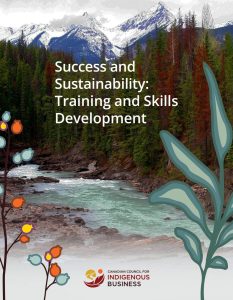
Success and Sustainability: Training and Skills Development
Indigenous participation in the forestry industry is critical for economic growth, environmental stewardship, and community sustainability. However, several challenges hinder full engagement, including skills shortages, limited access to training, procurement barriers, and a lack of integration between Indigenous Knowledge and Western forestry practices. This paper examines these issues and provides recommendations to strengthen Indigenous involvement in forestry.
Sharing Prosperity: An Introduction to Building Relationships for Economic Reconciliation in Ontario
Numerous treaties and UNDRIP Article 36 affirm the rights of Indigenous peoples to engage in international trade, particularly as a means of economic self-determination. Foreign trade zones (FTZs) established by Indigenous nations are expressions of economic self-determination. This policy brief recommends the establishment of mechanisms to recognize Indigenous FTZs in Canada and the facilitation of connections between Indigenous businesses in Canada with their counterparts utilizing FTZs in the United States.
Part I: Establishing Equity in Education & Employment for Indigenous Peoples
This first release of a multi-part report series by The Ontario Chamber of Commerce and CCIB is designed to guide businesses on their journey toward meaningful reconciliation. The first chapter outlines actions that employers, educational institutions, and governments can take to support Indigenous employment, strengthen partnerships with Indigenous communities, and embed reconciliation into organizational strategies.
Part II: Finance and Capital
This second release of a multi-part report series by The Ontario Chamber of Commerce and CCIB, A Way Forward: Finance and Capital outlines how financial institutions, resource companies, and governments can support Indigenous economic development by addressing systemic barriers and strengthening inclusive financial ecosystems. The report also explores how recent developments, such as the $10 billion Robinson-Huron Treaty settlement, represent opportunities to invest in Indigenous trusts, economic development, and governance capacity.
Part III: Procurement
CCIB and the OCC have released the third report in the A Way Forward series, focused on procurement. It highlights the need to break down systemic barriers and create equitable access to supply chains for Indigenous businesses. For non-Indigenous businesses, improving Indigenous access to procurement means access to a wider range of qualified bidders and services, helping them fulfill Indigenous participation requirements and make meaningful progress toward their reconciliation goals.
Part IV: Lands and Infrastructure
This chapter on Infrastructure and Development in the series, A Way Forward, recognizes the vital role of Indigenous Peoples as partners in creating a more inclusive and sustainable Ontario. By investing in respectful and meaningful partnerships and sustainable infrastructure, businesses can support Indigenous communities to thrive in the modern economy while preserving cultural continuity and addressing the infrastructure gap.
Indigenous Foreign Trade Zones
Numerous treaties and UNDRIP Article 36 affirm the rights of Indigenous peoples to engage in international trade, particularly as a means of economic self-determination. Foreign trade zones (FTZs) established by Indigenous nations are expressions of economic self-determination. This policy brief recommends the establishment of mechanisms to recognize Indigenous FTZs in Canada and the facilitation of connections between Indigenous businesses in Canada with their counterparts utilizing FTZs in the United States.
Exceeding 5% – Procurement and IEDCs
IEDCs are important pillars of economic success in Indigenous communities. They play a crucial role in generating their revenue independently of government funding. Given these factors, CCIB developed this policy brief to spotlight the importance and benefits of increasing IEDCs engagement in procurement opportunities. This is the final entry of a three-part series.
Exceeding 5% – Expanding Wise Practices in Federal Indigenous Procurement
To support increased Indigenous participation in federal procurement, this brief provides a preliminary overview of challenges and recommendations gleaned from a more comprehensive research project on the topic conducted by CCIB. The project involved qualitative, in-depth interviews with 9 Indigenous businesses with federal procurement experience and 8 representatives of different federal departments engaged directly with Indigenous procurement. This is the first entry of a three-part series.
Exceeding 5% – Expanding Wise Practices in Regional Indigenous Procurement
To best inform regional and federal approaches to Indigenous procurement, CCIB interviewed 10 Indigenous entrepreneurs and 11 regional procurement representatives (provincial, territorial, and municipal) to understand barriers, wise practices, and recommendations for effective Indigenous procurement. This policy brief presents a high-level overview of these findings with a particular focus on recommendations to support change in Indigenous procurement policy. This is the second entry of a three-part series.
Early Stages of Indigenous Women’s Entrepreneurship
A collaborative project between the Canadian Council for Indigenous Business (CCIB), the Women Entrepreneurship Knowledge Hub (WEKH) and the Diversity Institute (DI) aimed at studying Indigenous women’s entrepreneurship in Ontario. The report identifies the unique experiences of Indigenous women entrepreneurs and the critical areas of support that need further attention in the public and private sectors.

Think Growth – Increasing Access to Grocery Shelf Space: the 10,000 SKU Challenge
Industrial agriculture threatens sustainability and Indigenous food sovereignty. This policy brief recommends implementing the Métis-led Global Centre’s 10,000 SKU Challenge to empower Indigenous communities and promote sustainable, culturally rooted economic growth.
Partnerships In Procurement: Understanding Indigenous Business Engagement in Canada’s Defence Industry
Defence procurement has significant potential to support Indigenous businesses and economic development. However, Indigenous businesses remain underrepresented in the defence sector relative to their industry makeup and overall capabilities. In collaboration with Indigenous Services Canada, this research examines the barriers Indigenous businesses face when entering the sector, as well as the supports available to build capacity among those looking to engage as defence contractors.
Untapped Potential: A Case Study of Indigenous Economic Development Corporation Capacity in Federal Procurement
CCIB, in collaboration with Indigenous Services Canada, has undertaken this research to better understand the procurement experiences and relationships of Indigenous Economic Development Corporations (IEDCs), with a specific focus on federal supply chains. This report highlights the Mikisew Group of Companies as a case study, exploring the IEDC’s roles in procurement and its impacts on staff and the broader community.
Reviewing Regional Indigenous Procurement: Barriers and Wise Practices
This is the second report of a multi-report collaboration with Indigenous Services Canada (ISC) focused on Indigenous procurement. To best inform regional and federal approaches to Indigenous procurement, CCIB interviewed Indigenous entrepreneurs and regional procurement representatives to understand barriers, wise practices, and recommendations for effective Indigenous procurement.
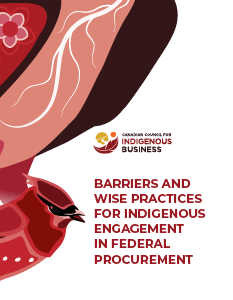
Barriers and Wise Practices for Indigenous Engagement in Federal Procurement
This research aims to gather insights from Indigenous businesses and federal procurement representatives to illustrate the challenges and opportunities for promoting Indigenous procurement as one of the tools for successfully achieving economic reconciliation. By interviewing ecosystem contributors from both sides of the procurement equation, we create an informative resource that acts as feedback on current procurement realities while also positing suggestions for procedural improvement.
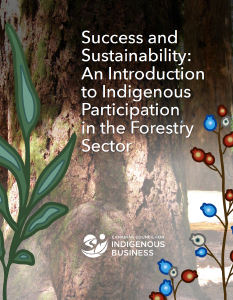
Success and Sustainability: An Introduction to Indigenous Participation in the Forestry Sector
Indigenous Peoples and communities have strong economic and cultural ties to the forestry sector, however, little information is available on how Indigenous businesses operate in the industry. CCIB is pleased to release this report, which aims to provide baseline information to fill these gaps with data focused on the involvement of Indigenous businesses, specifically those from First Nations and Métis communities.
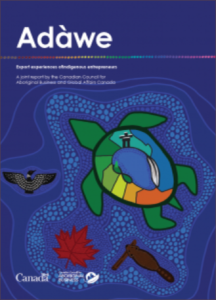
Adàwe: Export Experiences of Indigenous Entrepreneurs
The Canadian Council for Aboriginal Business (CCAB) and Global Affairs Canada (GAC) have continued our collaboration to explore the characteristics and challenges faced by Indigenous businesses that export. This partnership has resulted in two reports, the first of which is based on a national survey of more than 2,600 Indigenous business owners conducted from May to September 2021. The study also includes insights from community-based Indigenous entrepreneurs. To promote an inclusive approach to trade, this report presents a profile of Indigenous exporters, their key industries, and export markets of interest. The report also uses econometric analysis to determine the extent to which these factors are associated with the likelihood of exporting. The second report will focus on the challenges and barriers faced by Indigenous businesses when exporting.
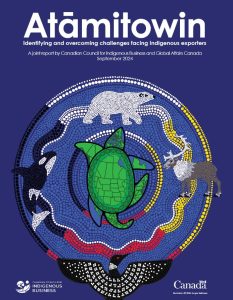
Atāmitowin: Export Experiences of Indigenous Entrepreneurs
Atāmitowin, the second and final report from our partnership with Global Affairs Canada, aims to enhance our understanding of the obstacles facing Indigenous entrepreneurs and exporters. Our previous report, Adàwe, sought to illuminate the exporting and business activities of Indigenous-owned small and medium-sized enterprises (SMEs). Atāmitowin builds upon this by examining the growth and exporting obstacles of Indigenous SMEs and explores Indigenous entrepreneurs’ recommendations about possible supports.



TRADE & EXPORT
Indigenous entrepreneurs are making headway in global markets. Read CCIB’s research on Indigenous exporting.

PROCUREMENT
Indigenous businesses have the capacity to support supply chains across all industries. CCIB research investigates corporate and federal Indigenous procurement practices and their impact on Indigenous business.

INDUSTRY
CCIB research examines Indigenous capacity, success, and challenges in industry-specific reports.

AEDCs
Aboriginal Economic Development Corporations play a major role in driving Indigenous economic advancement – CCIB regularly reports on their progress and goals.

PRIVATE BUSINESS
Through national survey reports on Indigenous businesses and partnerships with other organizations, CCIB has provided regular reports on Indigenous private businesses.

COMMUNITY DEVELOPMENT
CCIB has researched relationships between economic and community development through qualitative and quantitative measures.

SKILLS, INNOVATION & TECH
In response to today’s rapidly changing economy, CCIB research explores how Indigenous businesses adapt and innovate and what skills will be needed in the future.